
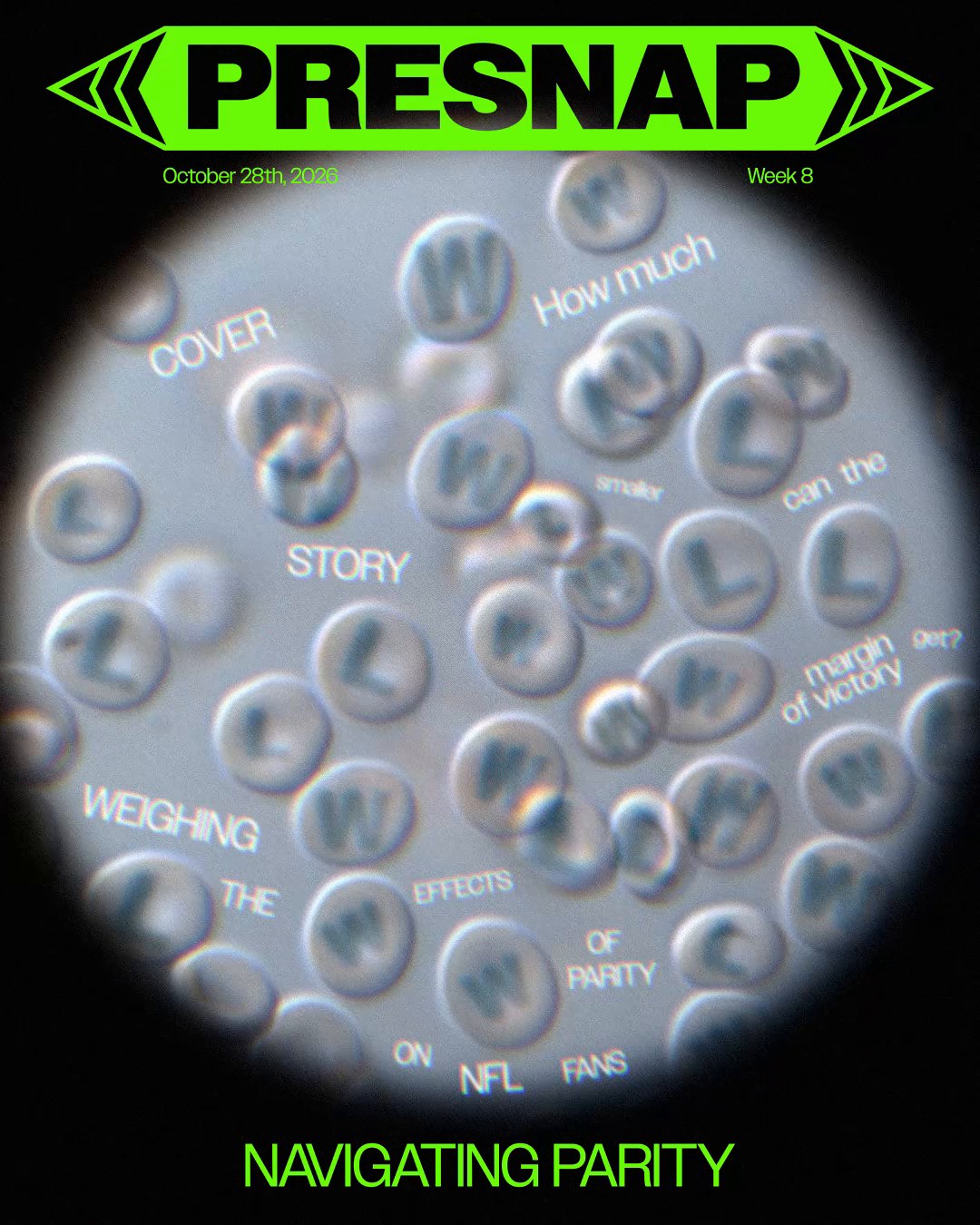
Navigating Parity
If it feels like there’s more close games this season, it’s because there are. Before I explain, I want to give a warning up top: this is going to be a stat-heavy issue. I’m going to quote a lot of things I read on the internet, and hopefully most of them are true. I am not going to source them. At PRESNAP, we try not to fall into the analytical death traps that plague other sports publications, but for this issue, we’re going to swan dive into it with no parachute.
Games this year are close. Really close. Through week 7 (not counting the Cowboys thrashing of the Eagles on MNF), there have been 64 games decided by one score or fewer. This is the most through week 7 in NFL history.
In week 7 alone, there were three games decided on the final play of the game. This has been a trend all year. 34 games this season had the game-winning score in the final five minutes of the fourth quarter, or in overtime. This is the most through Week 7 in NFL history.
We’ve also seen an abnormal amount of overtime games. There’s been 9 so far this year, and 6 overtime games in the last three weeks alone. That’s the most in a 3-week span since 2002.
So why is this happening this year?
Well it seems like this was always supposed to happen.
Bert Bell, commissioner of the NFL in 1952, famously said “The teams are so closely matched that on any given Sunday, any one team can beat any other team. Professional football has come down to the point where the psychological edge is the determining factor. Physically these clubs are even, so it depends on the mental outlook of squads to determine the winner. It’s this factor that has made the game close and is bringing fans out to the ball parks.”
70 years later, we’re saying pretty much the same thing. Andy Reid last year after a close loss told the press, “That’s this league right now. There is so much parity. That’s why I mentioned after the game the penalties, turnovers, and so on. You can’t have those; the games are too close, too much competition.”
Parity is foundational to the NFL. From the salary cap, to the draft process, to revenue sharing, every element of the NFL has been designed to reinforce parity, and after seventy years of refining this process, this year we are seeing the league’s most perfected form yet.
It’s perfect because the best team on the field doesn’t win every week. That’s not good TV. Games are decided by a handful of key plays, making it so anyone can win and anyone can get screwed. This means that every game is competitive, every team is valuable, and every slate of games can continue to attract advertisers. It’s the perfect product.
But there’s a question that I am stuck on: is this much parity good for fans?
On the surface, yes. Close games are more entertaining than blowouts. Waking up with the belief that you can win every week is better than the alternative. And for the casual, well adjusted fans that make up the majority of the audience, this leads to the best viewing experience.
But what about the sickos? I’m talking about the guy who’s putting his phone through the TV. The Mom with a sagging preseason Raiders Super Bowl tattoo.
These consistently close losses can take a toll.
In 1980, after the Los Angeles Rams lost to the Pittsburgh Steelers in a Super Bowl where the lead changed hands six different times, heart attacks rose sharply in the L.A. area and continued for two weeks. This has been documented after other major sporting events around the world: during the 2006 World Cup, when Germany went into a penalty shootout against Argentina, Munich hospitals saw a three to fourfold increase in the number of cardiovascular events.
But we’re talking about the regular season. A close loss in week 7 doesn’t have the same impact on a fan as losing the Super Bowl… right?
You might not have a heart attack, but in any close loss, a fan’s brain believes what it is witnessing is actual pain, despite being thousands of miles away watching in the comfort of their own home. Functional MRI studies show your brain activates the same neural pathway when witnessing a close loss in a sporting event that you activate when you see something horrifying, like a loved one being injured. Your brain literally cannot tell the difference.
While people who don’t enjoy sports will claim it’s just a game, losing is a universal experience, and our brains are programmed so that losing feels much worse than winning. According to Nobel laureates Daniel Kahneman and Amos Tversky’s “prospect theory,” losing anything feels significantly worse than winning, around 2-1. They tested this using a simple experiment where they offered people a coin flip and told them if it lands on tails they will lose $100. They then asked them if the coin lands on heads, how much money they would need to gain in order to take the bet. Mathematics will tell you that saying anything over $100 is a favorable bet, but the median response was $200.
This is why losing in the NFL in these close, one-score games hurts so much more than winning them. Every week we’re given a coin flip between losing a game and falling behind in the playoff race, or winning a game and surviving, only to be back up against the wall next week. The value equation isn’t fair in our heads, so in a league where every team, and every fan base, is technically in every game, you’re going to live through a lot more pain than joy.
So, is there anything we can do about parity? Probably not, but I do think there’s one proactive solution the NFL can take to help save fan’s hearts and minds:
One minute guided meditations during commercial breaks of one score games. Commercial breaks are filled with ads for DraftKings or Ozempic that remind you how much of a loser you already are, but with a meditation break, hopefully people will reset and remind themselves that this is just a game. The sad part is these guided meditations will probably have to be funded by gambling companies since they’re the only ones who can afford the price tag. At the end of the meditation, Matthew McConaughey or Kevin Hart will provide a promo code for a no-sweat bet, but as long as it’s at the end, I think that’s fine.
Until then, we’ll just have to hope there’s less nailbiters this week.